30,000 FT views tells a different story on college campuses throughout USA
NCAA BASEBALL FIELD SAFETY AUDIT 2026
Foul Ball Safety Now has conducted an independent review of 46 NCAA baseball fields across Division I, II, and III to assess the current state of protective netting and the risk exposure to spectators and the general public. Our findings confirm that dangerous conditions remain widespread throughout collegiate baseball and that NCAA facilities continue to operate without a consistent or enforceable standard of safety.
Methodology
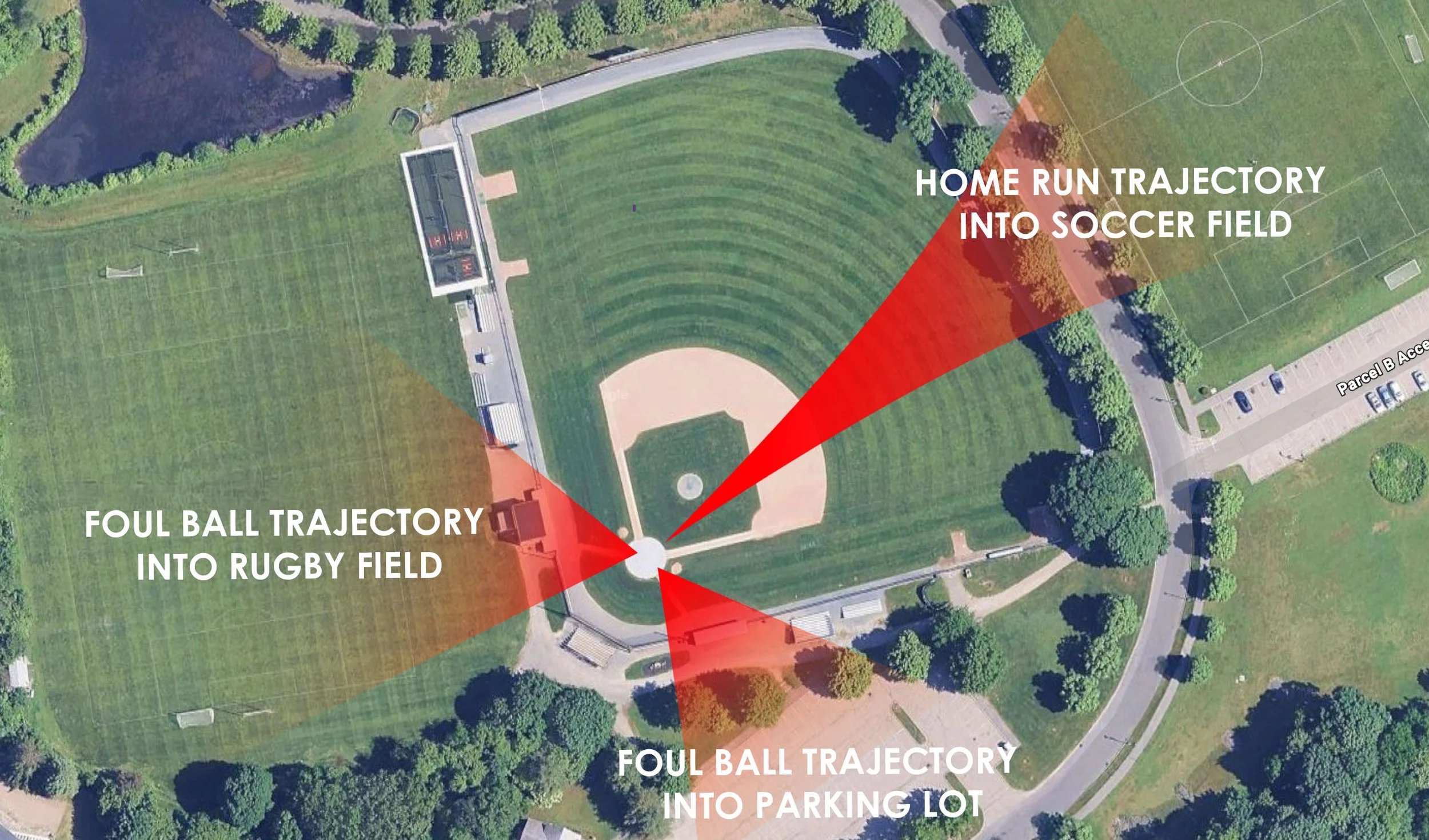
This audit was conducted using Google Earth satellite imagery and visual analysis to evaluate the extent and placement of protective netting, the proximity of stadiums to public and shared-use environments, field configurations, and adjacent athletic infrastructure. Each of the 46 fields were reviewed to determine whether foul and home run balls could reasonably enter unprotected areas beyond the field of play.
Findings
1. Inadequate Netting Is Commonplace
Across all NCAA divisions, the majority of fields reviewed operate with netting that is limited to protecting the area behind home plate, often ending at or near the dugout. This leaves baseline seating areas, outfield spectator zones, and the full perimeter of the field unprotected from foul and home run balls.
There is no indication of a uniform standard requiring extended netting, and protection varies widely from one ballpark to another.
2. Public & Shared Spaces Are Routinely Exposed
The audit revealed that a substantial number of NCAA stadiums are positioned in close proximity to unprotected public and shared use areas including parking lots, public roads and transportation corridors, residential housing, campus walkways, and recreational areas. Based on Google Earth analysis, these areas frequently fall within the natural anticipated trajectory of balls leaving the field of play.
This creates a scenario in which individuals who are not attending the game are unknowingly placed at risk, with inadequate protective barriers in place.
3. Multi-Use Athletic Complexes Increase Risk Exposure
A consistent pattern across the 46 facilities reviewed is the integration of baseball fields within multi-sport athletic complexes. In many cases, baseball and softball fields are placed in close proximity, adjacent fields host spontaneous athletic activity, and separation or protective barriers between fields is minimal.
Under these conditions, foul and home run balls can enter active athletic environments, exposing athletes, students, and families to risk while they are engaged in unrelated activities.
4. No Meaningful Safety Distinction Between Divisions
The audit found no meaningful difference in safety approaches between Divison I, II,
and III programs. Division I, II and III programs demonstrate inconsistent and insufficient netting coverage and operate with minimal protective infrastructure, leaving surrounding environments largely exposed. This shows a systemic absence of prioritization and oversight.
5. Lack Of A National Safety Standard
There is currently no enforceable NCAA-wide requirement mandating protection for spectators inside and outside the field, or consideration of surrounding public environments. As a result, each facility operates under its own interpretation of safety, leading to inconsistent, inadequate protection.
Conclusion
This audit confirms that NCAA baseball fields are operating under known dangerous conditions that extend beyond their fields of play. Across the 46 fields reviewed, netting is insufficient, public and shared spaces are regularly exposed, multi-use environments are increasing the likelihood of injuries, and no consistent safety standards exist.
Call To Action
Immediate action is required. The NCAA and its member institutions must conduct independent safety evaluations at every facility, address risks within seating and general public areas throughout the ballpark and in all surrounding environments, and establish and enforce a national safety standard that applies to every facility. Until these steps are taken, NCAA baseball will continue to operate under conditions that place spectators and the general public at unnecessary risk of injury or death.