2026 Updates: Follow Our Latest Investigations
Our ongoing efforts and activism to help prevent future fan injuries
Correspondence to Queens College and PS 499
Following up about Queens College ballpark safety concerns March 5, 2026
Dear Commissioner Grasso and East Coast Conference representatives,
I was encouraged to contact you by Governor Baker’s office, as you can see in the previous correspondence provided below for context.
Foul Ball Safety Now is deeply concerned about the threats to public safety and ECC/NCAA athletes’ mental wellness posed by the ongoing risk of baseballs leaving Hennekens Stadium and potentially entering the adjacent sidewalks and street where students from the neighboring public school and high school, as well as members of the public, could be injured. We believe this violates NCAA’s basic facilities safety standards, as well as NCAA policies designed to protect student athletes from anxiety and mental distress.
We have repeatedly raised this issue with Queens College administrators over the past year, but that dialogue has not produced action to address this safety hazard. The QC Knights’ 2026 baseball season is underway, with home games commencing as soon as March 14 against Mercy University (ECC competition).
Therefore, we would like to initiate discussion with your office or the appropriate ECC representatives. Please let us know when we can arrange a phone call. Or if preferred, please introduce us to the person involved with facilities management matters so we can give them more information and data that we have collected.
We pay close attention to this issue, and have a lot to share. We also believe this safety matter may be unaddressed at other ECC / NCAA campuses, and warrants a further investigation.
Thank you,
Jordan Skopp
Founder, Foul Ball Safety Now
(718)627-6767
Prior correspondence with NCAA and Quenns College follows Reply received January 22, 2026
Dear Jordan,
Thank you for sharing your concerns regarding foul ball safety and for providing the related correspondence and resources. Your emails have been shared internally.
To further advance your efforts, we recommend connecting directly with Queens College and the East Coast Conference, as they are best positioned to address facility-specific safety matters and implement any necessary changes.
For your reference:
• Queens College (CUNY) – Athletics Contact Page
• East Coast Conference (ECC) – Conference Contact Page
Please let me know if you need any additional information to facilitate those connections.
Best regards,
Lorraine Schumacher
Following up about Queens College ballpark safety concerns
Dear Governor Baker,
I copied you on a letter last week on an important NCAA sports-related safety matter at Queens College, where baseballs can exit the ballpark and potentially injure pedestrians on the sidewalk or schoolchildren in the adjoining public schoolyards. You were also copied on an earlier letter about this last November, and you can see all my related correspondence at https://www.foulballsafetynow.com/investigations.
I would like to speak with you about how to elevate this matter before baseball season resumes and people are put in harm’s way. I also believe this issue may be relevant at other NCAA campus sports facilities, and may warrant a more comprehensive safety review that your office could lead.
If there’s anyone on your staff who can organize a call for us to discuss these issues, that would be greatly appreciated.
Thank you,
Jordan Skopp
Founder, FoulBallSafetyNow.com
718-627-6767
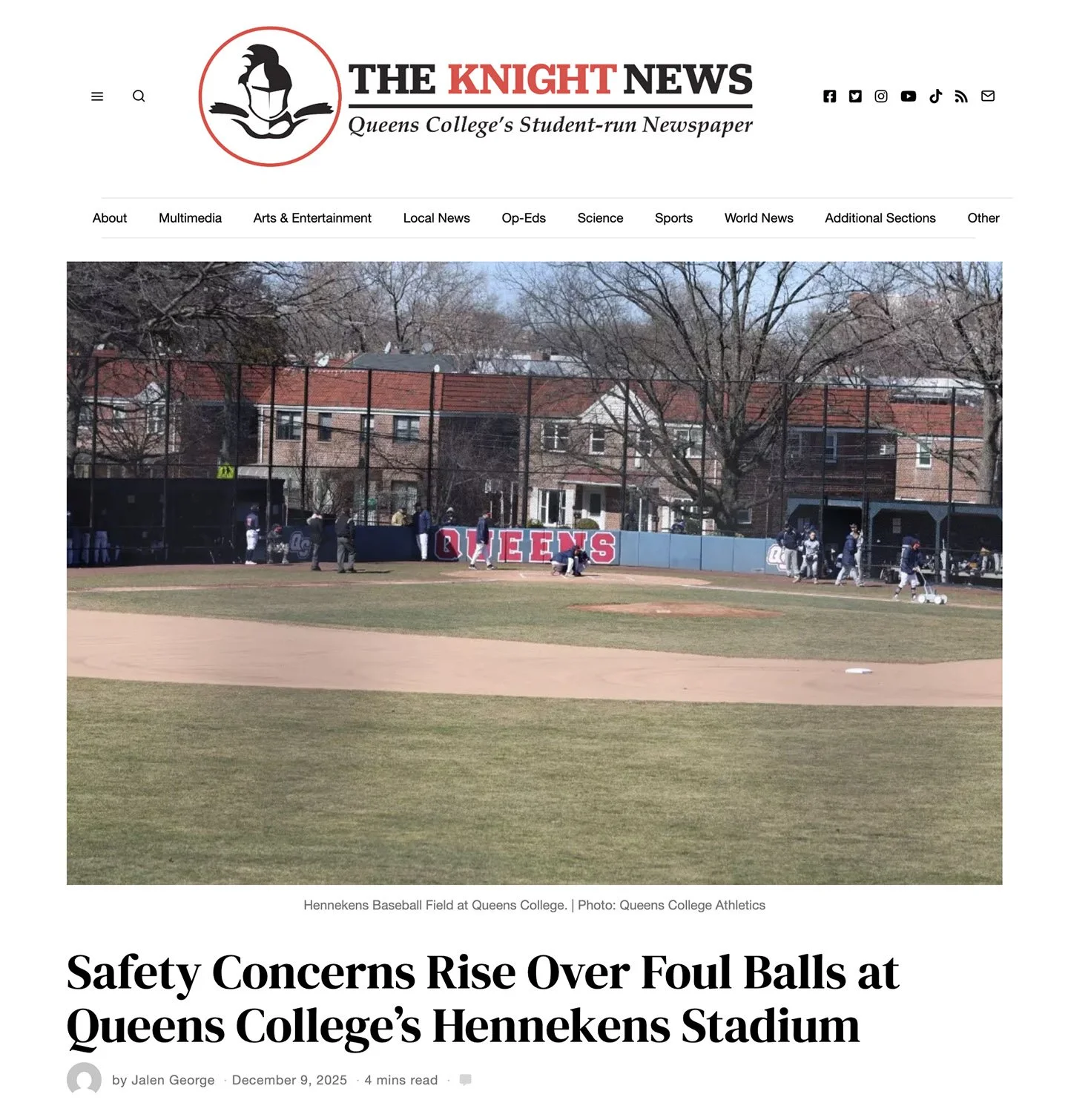
P.S. I encourage you to read the coverage by the Knight News, the student-run newspaper at Queens College, which highlighted these concerns in a December 9, 2025 article “Safety Concerns Rise Over Foul Balls at Queens College’s Hennekens Stadium.”
One Queens College article is the start to solutions Jan 12, 2026
Dear Mr. Twible:
I am writing to you and Queens College for the fifth time since May 2025, urgently seeking clarity from you on the serious safety concerns Foul Ball Safety Now and Queens College students have raised regarding batted baseballs exiting Hennekens Stadium. We remain concerned about the stadium’s physical layout and proximity to the surrounding community, including PS/IS 499 school.
If you have not already seen it, the Knight News, the student-run newspaper at Queens College, highlighted these concerns in a December 9, 2025 article “Safety Concerns Rise Over Foul Balls at Queens College’s Hennekens Stadium,”which I refer others copied on this letter to read. The article includes a comment from you stating that QC is “exploring the feasibility of installing additional barriers to further augment our ongoing commitment to a safe and secure environment. The safety of everyone on campus and in the surrounding community is of utmost importance.”
If that is indeed the case, we are concerned that this additional protection will not be in place by the time the Knights begin practicing in the coming weeks and hosting home games — sending potentially dangerous balls over the existing barriers. (The schedule has not been released publicly as of the time of this letter, but we presume home games will commence in late February or early March based on past seasons.)
Parents of children attending the neighboring PS 499 deserve the right to know that their kids could be exposed to dangerous baseballs leaving the field. The same right to know extends to unsuspecting pedestrians on the sidewalk on Reeves Ave, let alone passing traffic where a baseball could cause accidents.
How much longer do your student athletes have to suffer in silence? They are clearly presented with a conflicting signal from your administration as to how long they must continue playing in a ballpark that poses potential threats to the community members within reach of a baseball leaving their field. We believe you owe the student athletes a direct response and resources to support their mental health in relation to this matter.
This issue is not going to go away, and it warrants robust community dialog and temperature taking about exactly what is happening. We urge you to be transparent and forthcoming about the details and timelines of proposed construction of additional protective barriers to alleviate this safety threat.
Since it is now well past time for QC to have addressed this risk, we believe the NCAA should launch a formal review of QC’s compliance with all relevant NCAA safety regulations, mental health policy obligations, and basic principles of duty of care owed to the surrounding community.
Given your ongoing lack of transparency about the details of proposed improvements, I am copying on this letter Governor Charlie Baker, the NCAA president, as well as Kamar Samuels, the incoming Chancellor of New York City Public Schools, as well as local news outlets.
As our November 5, 2025 letter to you stated: NCAA policies make clear that member institutions must foster an environment that protects and supports the physical and mental health of student-athletes. This obligation includes a responsibility to remove unnecessary sources of distress and to ensure players are not placed in ethically compromising situations during practice or play.
As we’ve previously alerted you, the risks are not isolated to the Queens College community. There is a nationwide pattern of risk from balls flying outside of ballparks. Since Foul Ball Safety Now was founded in 2019, we’ve collected numerous testimonials from both victims and players to confirm this problem remains a very important matter to address in 2026.
For example, a woman in Modesto, California suffered a traumatic brain injury from a foul ball that struck her head while she stood in line outside a minor league ballpark during batting practice. A Tennessee resident contacted us about a high school baseball field where the risk of foul balls landing on the adjacent soccer field means the school doesn’t allow both sports to host games on the same day.
We’ve seen and heard about broken windshields in parking lots near baseball diamonds, at every level of the game. It’s not uncommon at all for potentially dangerous balls to fly around in areas where unsuspecting bystanders are in harm’s way.
This is an issue that is surely affecting other student athletes all over the country.
The fact that your student athletes have courageously stepped up is commendable. It’s time for Queens College to take their concerns seriously and act to protect the community.
I would be grateful to hear from you soon regarding concrete actions you are taking to address this ongoing danger immediately.
Sincerely,
Jordan Skopp
Foul Ball Safety Now
info@foulballsafetynow.com
718-627-6767
cc:
The Honorable Charlie Baker, President, NCAA
Kamar Samuels, Chancellor of New York City Public Schools
Shekar Krishnan, NYC Council Member for District 25
The New York Times
New York Daily News
New York Post
Newsday
Knight News
Follow-up Letter on Fan and Student-Athlete Safety at Hennekens Stadium Nov 5, 2025
Dear Mr. Twible:
I am writing to you and Queens College for the fourth time since May, seeking progress on the serious safety concerns I have raised regarding batted baseballs exiting Hennekens Stadium. We remain concerned about the stadium’s physical layout and proximity to the surrounding community, including PS/IS 499 school.
As you will recall, my concerns were triggered by a QC student athlete who contacted my organization, Foul Ball Safety Now, describing the climate of anxiety among his teammates from the presence of schoolchildren within reach of the dangerous errant balls. These Knights players say they’re wondering among themselves who might be the unlucky batter who seriously injures or kills an unsuspecting pedestrian on the sidewalk on Reeves Ave. or a child in the adjoining schoolyards of PS 499.
In our view, the combination of limited netting and the stadium’s placement next to a school raises questions about whether sufficient precautions are in place to protect the public.
It is now well past time for QC to address this risk and review compliance with NCAA safety regulations, mental health policy obligations, and basic principles of duty of care owed to the surrounding community. I also believe you owe the student athletes a direct response and resources to support their mental health in relation to this safety threat.
Given your lack of a significant response so far, I am copying on this letter Governor Charlie Baker, the NCAA president, as well as local news outlets. As Queens College has not taken action to address this serious safety threat within its control, I believe it is time for the NCAA to become involved.
NCAA policies make clear that member institutions must foster an environment that protects and supports the physical and mental health of student-athletes. This obligation includes a responsibility to remove unnecessary sources of distress and to ensure players are not placed in ethically compromising situations during practice or play.
As I previously have told you, the risks are not isolated to the Queens College community. There is a nationwide pattern of risk from balls flying outside of ballparks. Since I founded Foul Ball Safety Now in 2019, we’ve collected numerous testimonials from both victims and players to confirm this problem remains a very important matter to address in 2025.
A woman in Modesto, California suffered a traumatic brain injury from a foul ball that struck her head while she stood in line outside a minor league ballpark during batting practice.
A Tennessee resident contacted me about a high school baseball field where the risk of foul balls landing on the adjacent soccer field means the school doesn’t allow both sports to host games on the same day.
We’ve seen and heard about broken windshields in parking lots near baseball diamonds, at every level of the game. It’s not uncommon at all for potentially dangerous balls to fly around in areas where unsuspecting bystanders are in harm’s way.
This is an issue that is surely affecting other student athletes all over the country.
The fact that your student athletes have courageously stepped up is commendable. It’s time for Queens College to take their concerns seriously and act to protect the community.
I would be grateful to hear from you soon regarding action you are taking to address this ongoing danger.
Sincerely,
Jordan Skopp
Foul Ball Safety Now
info@foulballsafetynow.com
718-627-6767
cc:
The Honorable Charlie Baker, President, NCAA
The New York Times
New York Daily News
New York Post
Newsday
Knight News
Follow-up Letter to Queens College and public school community Sept 10, 2025
Dear Mr. Twible and colleagues from Queens College, PS 499, parent teacher representatives and team members,
I am following up to inquire whether any progress has been made over the summer to resolve the serious community safety concerns that I brought to your attention earlier this year regarding foul balls exiting Hennekens Stadium.
I want to reiterate that I’m only contacting you because a QC student athlete contacted my organization to alert us to this matter, and expressed concern about the climate of anxiety among his team members brought on by the presence of school children in the surrounding vicinity within reach of a foul ball.
Now that the school year is underway, I’d like to know what actions have been taken by QC to address this risk and review compliance with NCAA safety regulations, mental health policy obligations, and basic principles of duty of care owed to the surrounding community.
I’d also like to reiterate that this problem is not isolated to the Queens College scenario. There is a nationwide pattern of risk from balls flying outside of ballparks.
A woman in Modesto, California suffered a traumatic brain injury from a foul ball that struck her head while she stood in line outside a minor league ballpark during batting practice.
A Tennessee resident contacted me about a high school baseball field where the risk of foul balls landing on the adjacent soccer field means the school doesn’t allow both sports to host games on the same day.
At another high school ballpark adjacent to a residential neighborhood, a family is scared to let their kids outside during practices and games as balls regularly fly into their house and yard.
We’ve all seen and heard about broken windshields in parking lots near baseball diamonds, at every level of the game. It’s not uncommon at all for potentially dangerous balls to fly around in areas where unsuspecting bystanders are in harm’s way.
This is an issue that is surely affecting other student athletes all over the country.
The fact that your student athletes are stepping up and acknowledging their own anxiety and having the courage to come forward is commendable. They are modeling responsible behavior that others have not yet exhibited elsewhere.
While I look forward to your reply and hope to hear of positive steps taken, I believe you owe the student athletes a direct response and resources to support their mental health in relation to this safety threat.
Sincerely,
Jordan Skopp
Foul Ball Safety Now
info@foulballsafetynow.com
718-627-6767
Letter to Queens College and public school community July 23, 2025
Re: Follow-Up on Fan and Student-Athlete Safety at Hennekens Stadium
Dear Mr. Twible,
Thank you again for your earlier response and for taking the time to consider the safety concerns we raised about Hennekens Stadium. Foul Ball Safety Now remains deeply committed to ensuring student-athlete well-being at sporting venues. We appreciate your willingness to review this matter in detail.
In the time since our last correspondence, we’ve continued to evaluate the conditions at Hennekens Stadium through the lens of NCAA safety regulations, mental health policy obligations, and basic principles of duty of care owed to the surrounding community.
We remain concerned about the stadium’s physical layout and its relationship to the broader community, including the proximity of the field to PS/IS 499 School. The potential for injury to students, school staff, and other community members because of foul balls leaving the field is real. In our view, the combination of limited netting and the stadium’s placement next to a school raises questions about whether sufficient precautions are in place to protect the public.
We have heard from players who describe experiencing ongoing stress stemming from the fear that a batted ball could seriously injure someone. No athlete should bear the weight of that fear while trying to compete. NCAA policies make clear that member institutions must foster an environment that protects and supports the physical and mental health of student-athletes. This obligation includes a responsibility to remove unnecessary sources of distress and to ensure players are not placed in ethically compromising situations during practice or play.
We urge Queens College to review this matter in collaboration with its Sports Medicine Team, which may be in the best position to evaluate the psychological toll reported by student-athletes and to recommend appropriate institutional responses.
We would also appreciate a written response addressing any steps Queens College is taking to support student-athletes’ mental health in relation to this ongoing concern.
Thank you for your continued attention to this matter. We are hopeful that Queens College will act swiftly and thoughtfully to ensure the safety of its players, fans and the neighboring community.
Sincerely,
Jordan Skopp
Founder, FoulBallSafetyNow.com
718-627-6767
Letter to Queens College and PS 499 May 6, 2025
Subject: World Series summit on foul ball safety
Dear Queens College, PS 499, parent teacher representatives and Knights baseball team,
Now that the college baseball season is over, I believe it is the right time to convene an urgent meeting to review and respond to ongoing threats to fan safety around Hennekens Stadium, where protections against dangerous batted balls are insufficient.
How do I know?
I was alerted recently about this threat by one of your student athletes who was feeling anxiety and expressed this to me, and he also said it was the sentiment of his teammates. I was reminded of that exchange recently when I was contacted by a law firm representing a woman who is suffering from a lifealtering brain injury after getting hit by a foul ball standing outside a professional baseball facility in California.
The Knights players have concerns regarding the safety of children and adults in harm’s way from balls leaving the field, whether into the stands or over the fence. These players say they’re wondering among themselves who might be the unlucky batter who seriously injures or kills an unsuspecting pedestrian on the sidewalk on Reeves Ave or a child in the adjoining schoolyards of PS 499.
College players can hit the ball plenty hard and far enough to threaten innocent bystanders, let alone fans who are actively watching the game.
Balls flying at heads anywhere pose an unacceptable risk. To be clear, you are just one of many facilities who appear to have unsafe conditions. The question I pose is straightforward: do you have the courage to start a dialog to face this problem head on?
What I’ve heard from your student athletes recently has inspired me to respond, and that’s the spirit in which I reach out to you now. I’m a sounding board – offering a voice for the anonymous players, and my own expertise leading an ongoing advocacy campaign called Foul Ball Safety Now, which I founded in 2019. We’ve collected more than enough testimonials from both victims and players to confirm this problem remains a very important matter to address in 2025.
This compels a conversation, a productive dialog and systemic review that leads to a solid action plan to prevent fan injuries.
I look forward to hearing from you soon.
Thank you,
Jordan Skopp
Founder, FoulBallSafetyNow.com
718-627-6767
P.S. Queens College Knights baseball team players are receiving this letter directly via social media messaging.
cc: The Knight News